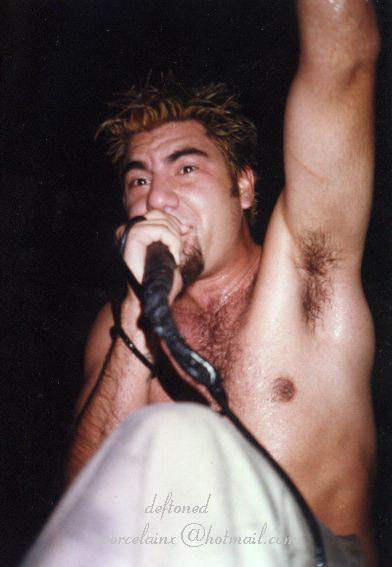
PONY EXPRESS
Sacramento’s DEFTONES balance angst and ambience with White Pony.
by David Simutis
www.deftonesworld.com
———————-
As a rule, hip-hop inflected metal is the hair metal of the 90’s. With White Pony Sacramento’s
Deftones prove that they’re not going to be the White Lion of their generation. To be sure, the
band’s third CD is the kind of rock the kids are cranking at skate parks and in their bedrooms,
but beyond the raging slabs of metallic guitars and wide-open drums, singer Chino Moreno does
more than rap over riffs. For one thing, he directs the brittle ambient keyboard and drum
machine floater, “Teenager,” which sounds like Moby. No lie.
“That’s kind of a teenage love song, one of those ‘crush’ kinds of songs,” says the soft-spoken
singer/guitarist. “Every time I heard the music, it reminded me of not having any worries–the
only thing that meant anything to you was if the girl in your second period class liked you or
not. It was just an overwhelming feeling that once you get older and you have so much other
stuff going on in your life, you forget about the little things. It was going to be a song for
this other project I have called Team Sleep–it’s a whole record of slow, ambient stuff like
that. I just asked everybody if they minded putting it on our record and they said no and then
added stuff to it. I wasn’t sure that it would actually work on the record, but after we started
getting the songs together it worked.”
It segues easily because the rest of the band–guitarist Stephen Carpenter, DJ Frank Moreno,
bassist Chi Cheng, and drummer Abe Cunningham–get into hypnotic grooves, adding weight to the
attack without simple aggression. The first single, “Change (In the House of Flies),” has a low,
slinky pulse, augmented by space-filling keyboards–reminiscent of the arty-groove that Jane’s
Addiction nailed–before erupting with torrents of guitars. In that opening bit, the Deftones
show that they know that there’s more to power than just cranking the distortion–to make this
kind of rock interesting, it’s all about tension and release.
“Even though it’s heavy, I think we kind of steered away from it being straight angry,
aggressive, heavy kind of music,” says Moreno. “We tried to make more of a soothing heavy
record, instead of like a big teenage anger kind of record.”
The group released their first album, Adrenaline, in 1995, around the same time that heavy rock
was falling from favor. It still managed to go Gold, selling over 500,000 copies. Their band’s
second record, Around the Fur, came in 1997, just before the rap-rock explosion of Korn, Limp
Bizkit, et al. The band did the Ozzfest and Warped Tour things, and Fur also went Gold. But they
were on the forefront of the new heavy movement. Now that popular culture has caught up with the
band (White Pony debuted at #3 on the Billboard Top 200 chart, selling just under 178,000 copies
in its first week), it is the Deftones’ time.
Moreno isn’t sure of the cause of the swing back to heavy music, but he isn’t complaining.
“I think a lot of people are starting to open up more to different stuff. At the time when our
last record came out they weren’t playing anything heavy on the radio; everybody was so hyped
on electronic music just taking over,” he says. “I don’t know, any time somebody tells you
what’s going to be hip, I think people automatically steer away from it and try to find
something a little bit left field of what’s popular.”
Part of their left-field appeal comes from Moreno’s mutable singing style, which allows him to
scream his way through blazers like “Street Carp,” bellow in a creepy way on “Knife Party” and
match guest and Tool/A Perfect Circle singer Maynard James Keenan note for note on “Passenger.”
But there’s an overarching artiness to White Pony that stems from the music, not just the
frontman. Moreno says that there wasn’t any pressure to cash in on the trend of heaviness.
“Not really,” he laughs. “At the beginning there was some pressure from the label saying, ‘Heavy
music is getting a lot of airplay right now.’ When our last record came out it was very rare
that anything heavy was getting any airplay. So they were like, ‘This is your time to put a
record out.’ At first we were like, ‘Alright, we should get one out.’ But all of us in a way
think that we helped pioneer this movement, and I don’t think any of us wanted to feel like we
were hurting the other records just trying to catch the wave of whatever this is going on with
music right now. We figured we should just take our time and put out a good record.”
But that wasn’t enough for everybody. A radio station in Phoenix aired “Change” after getting it
off Napster.
“It sucks in a way,” he says. “I understand that people want to hear it, and the majority of
people that are downloading it are Deftones fans. It’s been a long time since we put out a
record, so they really want to hear the music. It also kind of sucks because we’re not like,
a platinum artist, so every record we sell matters to us. I still think a lot of people will
buy the record, but at least they could wait until the record comes out. I was one of those
kids that sought out music, finding bootlegs–I still collect bootlegs, I love that kind of
stuff, so I can understand why kids want that kind of stuff. There’s also a lot of really cool
stuff from us. I was looking around and I saw, like, there’s versions of us doing Weezer songs
live and it sounds crappy, but I think there’s a lot of novelty stuff. I think people are pretty
much going to buy our record anyway.”
Indeed, the Deftones are more artsy than angsty. The Electronic Press Kit (EPK) sent in advance
to press outlets isn’t the standard clips of music and brief interview–theirs is a short film
that’s sort of post-apocalyptic noir. The band plays on televisions watched by people with
loose, decaying skin and wearing oxygen masks. The EPK is so off-the-wall that it is actually
being screened at art house movie theaters.
Moreno says, “Yeah, I just saw that the other day. We just filmed our performance part and I
hadn’t seen any of it, I’d just read the treatment. It’s pretty weird.” But he’d much rather
talk about the “Change” video. He wrote the treatment for the clip, which was filmed in his
house.
“We got a ton of video treatments sent to us and they were all pretty much over-artsy, trying
to take us out of our element,” he says. “Or they were just straight up silly, basically having
us perform and having all these skateboarders and **** like that. Everything was either too
complicated or too easy. So I just ended up writing my own treatment with Chi. The label sent
it out to Nigel Dick, the director. I wanted to have performance in it, but not be us on a stage
with a bunch of kids with tattoos and piercings stage-diving. I don’t think we need that. And at
the same time we don’t need us in a desert dressed in Gucci clothing trying to look weird. I
figure if we film it my house it’s pretty much us, so it’s a true sense of what we do.”